

How Business Disputes Are Resolved
Business litigation is the structured process used to resolve disputes arising from business relationships, transactions, and operations. It begins with the development of a clear chronology of events and a full assessment of damages, which provides the foundation for effective, leveraged negotiation.
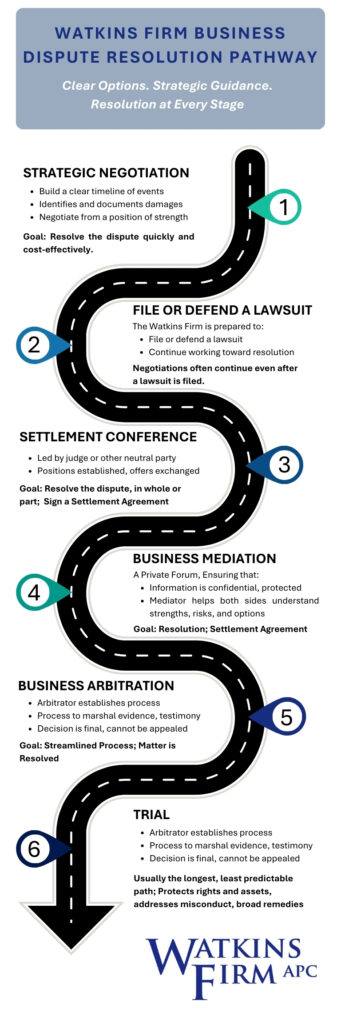
When resolution is not fully achieved, the process may continue through formal legal procedures including the filing of a lawsuit, court-supervised settlement efforts, mediation, arbitration, and, when necessary, trial and appeal.
At the Watkins Firm, business disputes follow a structured path that begins with preparation and leverage, and proceeds into formal dispute resolution and litigation only when necessary.
The Watkins Firm approaches business disputes through a structured process:
- Chronology and Damage Assessment
A detailed reconstruction of events and a complete understanding of all available damages establishes the factual and financial foundation for the case. - Effective, Leveraged Negotiation
With that foundation in place, negotiations begin from a position of strength. Many disputes can be resolved at this stage when leverage is properly established. - Filing of a Lawsuit (if necessary)
If negotiation does not fully resolve the dispute, one party may initiate formal legal proceedings. - Continued Negotiation and Court-Ordered Settlement Conference
Even after filing, negotiation continues. Courts typically require a structured settlement conference to encourage resolution. - Private Mediation
Parties may engage an experienced mediator to work toward a negotiated agreement outside the courtroom. - Arbitration (when required or agreed upon)
Many business contracts require arbitration as a binding alternative to trial. Arbitration typically results in a final, binding decision with limited rights of appeal. - Trial
If resolution is not achieved through prior steps, the dispute proceeds to trial, where a judge or jury determines the outcome. - Appeal
In some cases, the outcome of a trial may be reviewed through the appellate process.
Resolution often occurs in stages. Portions of a dispute may be resolved through negotiation, settlement conference, or mediation, while other issues continue forward.
The Watkins Firm resolves the vast majority of business disputes through effective, leveraged negotiation. When disputes are properly structured from the outset, many matters can be resolved efficiently while still accomplishing the client’s objectives.
This approach is grounded in nearly four decades of experience representing San Diego businesses in complex disputes.
Understand Your Position Early
If you are dealing with a business dispute, an early understanding of the facts, potential damages, and available options can make a meaningful difference in how the matter is resolved.
Call 858-535-1511 or contact the Watkins Firm to discuss your situation.
Types of Business Litigation Matters
Business litigation encompasses a wide range of disputes arising from business relationships, transactions, and operations. While each matter presents its own facts and challenges, most disputes fall into several core categories. Understanding how a dispute is classified helps define the appropriate strategy, identify potential remedies, and determine the most effective path toward resolution.
Most business disputes fall into several core areas:
Contract and Commercial Disputes
Disputes involving the formation, interpretation, performance, or enforcement of business agreements are among the most common forms of business litigation.
- Breach of Contract
- Business-to-Business (B2B) Disputes
- Failure to Pay / Failure to Perform
- Disputes with Contractors and Subcontractors
These disputes often arise when a party fails to meet its obligations under a business agreement, whether through incomplete performance, defective work, or non-payment. Issues involving failure to perform on a contract or poor workmanship and failure to pay for goods or services can quickly disrupt operations, strain relationships, and create immediate financial pressure if not addressed early.
Ownership and Governance Disputes
Conflicts between owners, partners, or stakeholders can affect control, financial distributions, and long-term business stability.
Conflicts between owners, partners, or stakeholders often involve control of the business, access to financial information, or the use of company assets. Situations involving embezzlement or misappropriation of funds or the commingling of business and personal accounts can undermine trust and expose both the business and its owners to significant legal and financial risk.
Employment and Defense Litigation
Businesses must respond to claims brought by employees or regulatory bodies, often involving complex statutory frameworks.
- Wage and Hour Claims and Unpaid Overtime Disputes
- Employer Defense, including Wrongful Termination and Retaliation
- Defending PAGA and Representative Actions
- Class Action Defense
Employment-related disputes frequently arise from wage and hour claims, termination decisions, or regulatory enforcement actions. Businesses facing these issues must often respond quickly to protect their position, particularly when dealing with statutory claims or representative actions such as those addressed in defense for California employers in PAGA litigation, where early evaluation and strategy are critical.
Fraud and Financial Misconduct
These matters involve allegations of dishonesty, misuse of funds, or improper financial conduct.
Allegations of fraud or financial misconduct can emerge in transactions, partnerships, or ongoing business operations, often involving claims of deception or improper conduct. Matters involving deceptive or unfair business practices may carry significant legal exposure and reputational consequences, particularly when they affect customers, investors, or business partners.
Industry-Specific Business and Commercial Disputes
Certain industries and operational contexts present unique legal challenges requiring focused experience.
- Real Estate and Partition Disputes
- Construction and Contractor Disputes
- Healthcare and Medical Practice Disputes
- Insurance Bad Faith
Certain disputes arise within specific industries or operational contexts, where the underlying business activity shapes the nature of the conflict. Whether involving construction performance, real estate interests, or other sector-specific issues, these matters often intersect with broader concerns such as contractual obligations, financial exposure, and the standards governing professional conduct.
Each of these categories follows the same underlying process: establishing a clear chronology of events, developing a thorough understanding of the available and potential damages, creating leverage, and working toward resolution through effective negotiation or, when necessary, formal legal proceedings.
 Business disputes do not remain static. They evolve over time as facts develop, positions harden, and financial exposure becomes clearer. Decisions made early in the process often shape the range of available options later, including whether a matter can be resolved efficiently or must proceed through formal litigation.
There are defined timeframes that apply to many business disputes, including statutes of limitation, contractual deadlines, and procedural requirements. These timeframes begin running well before many businesses recognize the full scope of the issue. Waiting too long can limit available remedies, restrict strategic options, and increase overall cost and risk.
The Best Chronology Wins.
Leverage in a business dispute is not created at the moment of negotiation. It is built through preparation. A thorough, well-documented chronology of events, supported by a mastery of available and potential damages, allows us to guide our clients with clear insight into their position and to engage from a position of strength. Without that foundation, decisions are made with incomplete information, and the range of effective options becomes limited.
As a dispute progresses, the cost of resolution typically increases. What may be resolved through early, structured negotiation can become more complex once formal claims are filed, discovery begins, and positions become more entrenched. At each stage, the range of practical outcomes narrows.
Early evaluation provides clarity, allowing a business to understand the legal issues involved, the potential exposure, and the strategic options available before those options are limited by time or the extent to which the dispute has progressed.
Additional Insight: Resolving Business Disputes
“Episode 11 – Resolving Business Disputes”

“Episode 12 – Resolving Business Disputes, Part 2″


Call 858-535-1511 for a Free Consultation
A Clear Understanding Changes the Outcome
If you are dealing with a business dispute or evaluating your options, the timing of your decisions and the clarity of your position can materially affect the result.
A well-developed chronology and a full understanding of potential damages provide the foundation for effective strategy, whether the matter is resolved through negotiation or proceeds further.
Speak with a San Diego Business Litigation Attorney with 40 Years of Experience
Call for a free consultation today, at 858-535-1511 or contact the Watkins Firm to discuss your situation.